Difficult Books Worth Reading
And Some That Are Not

When Cormac McCarthy died recently, my phone blew up with texts and calls—for many people, I’m their token well-read friend. McCarthy’s work has picked up a lot of readers in the last 10 years, due mainly to the entry points of The Road and No Country for Old Men. It’s been a while since such an enigmatic American author has died, and my friends just wanted to talk about what his writing meant to them, and his career overall. For me, one of the joys of reading a novel is talking about it once in a while for many years afterward. McCarthy’s Blood Meridian was something I read in the ‘90s and still have conversations about today.
Most people don’t read novels anymore, although they may be reading overall more words per day in the form of social media captions and tweets, and it’s less likely that when they do read a novel, it’s not one of the “difficult” ones. I get it! Most of my favorite all-time authors are easy to read, and can even be funny. There are plenty of people who don’t like Charles Bukowski, but no one ever said that they didn’t “get” Post Office. Blood Meridian, however, is one everyone could use a little help with.
There are plenty of novels that are like mountains to climb, a show-off read to lord over your fellow book nerds that you completed something they haven’t. You can keep them on your shelf like a hunter keeps mounted trophy heads. Just finishing one of these books is some kind of snooty merit badge to display on your smartypants sash.
What’s the real point to reading one of these? Why bother, once you’re out of school and you want something easy to read on a vacation? Look, there are plenty more difficult books out there than these, but there are books, that too many readers are worth the journey—they show us something about ourselves or a way to look at the world we haven’t thought of before. Simply put, when you’ve read a great book your entire perception of your own existence can change.
So here we go, with the real point of today’s post: difficult books of my life, and what I thought of them. For the most part, these books changed how I wrote. I’m sure I’m leaving a few out, but here are the main ones I’ve thought of.
Difficult Books I’m Glad I Read
Blood Meridian
Cormac McCarthy’s weird Western novel is to books as El Topo is to film. It’s a nightmarish portrait of violence and death in the Old West. As much as a hacky Western romaticizes the life of a gunslinger, Blood Meridian makes it seem like a horrifying existence. There is one description of dead babies hung up in a mesquite bush that, in my opinion, is the craziest, scariest image in literature. McCarthy changed how I described images in both my prose and my poetry. If you’re just getting started on McCarthy, Child of God is a great entry point.
Naked Lunch
William S. Burroughs is more famous as an image and a character than he is as a writer. The way he dressed, his love for guns, and his distinctive nasal drone are more well-known than his actual text. Hell, he was a guest on Saturday Night Live when that show still had subcultural value.
Naked Lunch is Burroughs’ story of morally-degraded heroin addiction. Mind you, what this novel is about is up for debate. The structure is random—the story goes is that it was in piles all over his house and was submitted to the publisher in the order that Allen Ginsberg gathered it up into a stack. It can be read in any order, and if you try this, the novel changes into different books. If you’re looking for something easier, check out Exterminator!
As far as I’m concerned, Naked Lunch is the fence between reality and utter nonsense. This is the outer boundary of what I can write. I can’t go further out than this and still have a piece of writing anyone can follow. But it’s also a mind set completely free to create, unbound by reader expectations, which is a state I try to get into before I begin writing.
The Sound and the Fury
William Faulkner intended there to be two colors of text for this book to help the reader know when the story was taking place; it shifts between two timelines occurring in the same physical space. The publisher told him that would cost the same as printing two books, and printed the whole thing in black text. What we’re left with is a book that jumps around in time, sometimes in mid-sentence, with no fair clues. If I hadn’t read this as part of a college course, I probably wouldn’t have gotten very far. It really helped having someone guide me through it. An easier story to start with is The Bear, which is not easy overall.
Faulkner is one of the all-timers of Southern literature. No one else captured the dark weirdness of the South like he did. Combining him with Flannery O’Connor is a no-brainer. If you grew up in the South like I did, and read all of those two writers, it should unlock everything about your childhood you need to write about. Also recommended for this is Harry Crews’ A Childhood: Biography of a Place.
The Bible
I read through this several times growing up, and considered it fact until I was 17. The King James Version has great poetic value, but the most troublesome language. There are entire books that are just dull (Numbers). There are stories of vengeance and wrath and great wars (the two books of Kings). Mad prophets, visions, miracles, and one story of a bear eating some kids that sticks with me.
My understanding of all the great literature I read after was seen through this lens. And it also prepared my young mind to accept stories with other meanings that need to be interpreted and deciphered. By reading this as a child, frankly, it made everything else seem easy. I don’t think I would have gotten all the way through it, though, had it not been part of my cultural upbringing.
Difficult Books I Gave Up Reading
Infinite Jest
This brick of a book is over a 1000 pages and it’s not hard to find used, often barely opened. It’s awkward to carry around, but easy to show off. 10–15 years ago it was adopted by millennial book nerds as some kind of portal into a club. Think of the guys who like to explain Inception to you even though you totally didn’t need it explained, but they’re sure that since it’s not your favorite movie, you just didn’t get it. This book is the reason that a lot of writers used smug footnotes in their books, and it’s where Dave Eggers copped his style for A Heartbreaking Work of Staggering Genius.
I passed on this for a long time until I met a woman I liked who was reading it. Yep. I read it trying to get a date. But quickly, I saw it as a 1000-page suicide note, and it broke my heart to keep going. The woman also broke my heart, but that’s another story and not even that good—she confessed after a few dates that she really wanted to date a friend of mine instead, who turned out not to be interested in dating her, and then it was all too weird. I don’t think she finished the book either.
I did read David Foster Wallace: The Last Interview, part of the fantastic series. I genuinely like his ideas, but this writing was just too unwieldy. I think, as an editor, I could have cut this into five good, readable novels.
Moby Dick
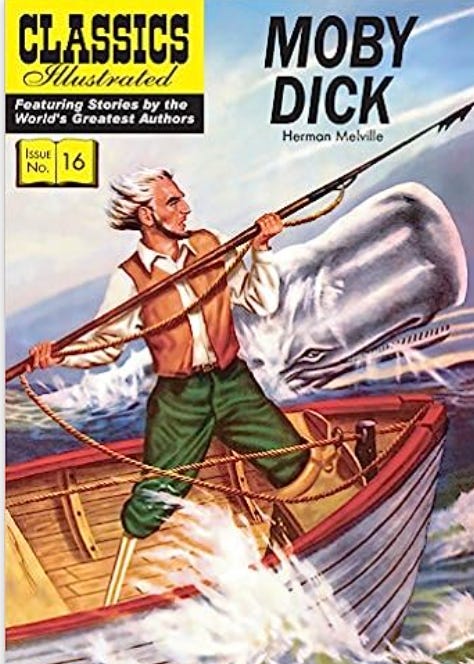
Oh, I want to have read this. I tried! But there are pages and pages of descriptions of rendering whale blubber and tying knots and all that, and the prose itself just makes my eyes wander away from the page. I read a Classics Illustrated comic book of it as a child many times. I love the story, I just can’t read this book.
Heart of Darkness
How does such a tiny tome defeat me every time I try? It’s supposed to be some great book of literature, but I just can’t hold my attention to it. I’ve seen Apocalypse Now so many times but can’t get more than ten pages or so in this book.
Milton, Chaucer, and Shakespeare
As an English major, I should have understood this stuff better but I just didn’t. Without the help of study guides I never would have known what they were talking about. The themes and ideas are copied and alluded to in so many other stories, I wish I had a firm grasp on them. I wish I could write my own versions in screenplay forms with pitches like “It’s King Lear in deep space!” but alas, I cannot.
Difficult Books I’ve Never Tried
Ulysses
When I went to college the first time in the late ‘80s, this is the book that all the English major snobs were trying to take down and write their own theory about. This is back when I did most of my reading on the bus and I needed to carry a physically smaller book around. I read a few paragraphs in a bookstore but put it back. During the pandemic I thought “now’s the time!” but if I didn’t get around to it then, I probably never will.
War and Peace
Even when I was a kid, I knew about this 1000-page book of Russian literature. Honestly, I’ve never gone near it. I know one guy who took it with him to Alaska where he had a lot of down time on a boat with no other entertainment other than reading. He called it a Stuck On A Boat book.
You should read War and Peace. It's long but an easy and excellent read.